How a FirmTrove record is built: sources and three layers
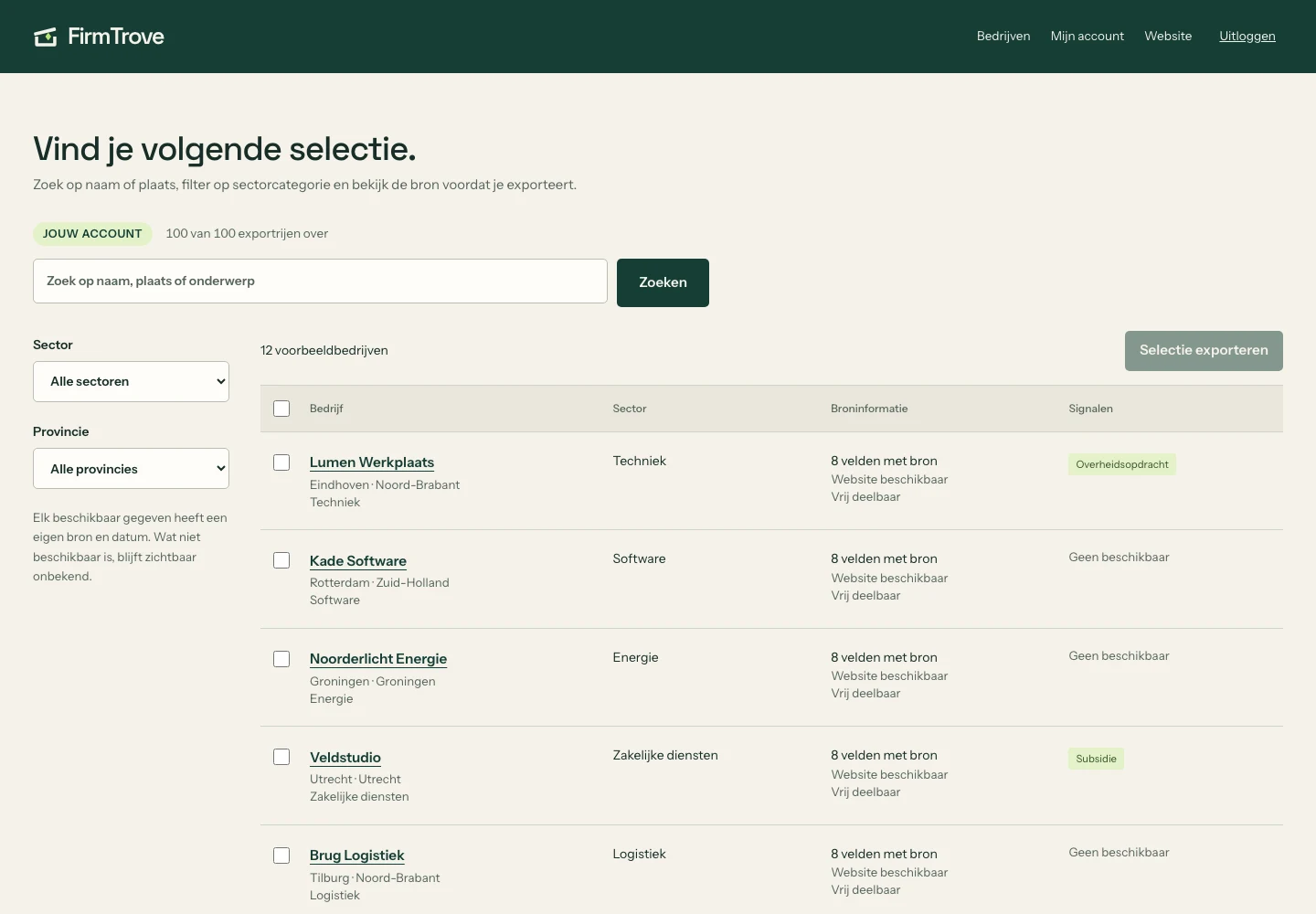
TL;DR: FirmTrove builds its company database in three layers. Each source keeps its own sighting of a company, with a first and last observation and the version of the source terms. Separate facts each carry an observation date and evidence, and sightings of the same company are merged into one row, the only derived step. The record you see takes name and city from the newest sighting, with a source and date on every field.
A FirmTrove record starts with source mentions linked to a company. The system stores observed facts and uses them to assemble the record you open in the explorer.
FirmTrove builds and maintains the company database you search; FlintLead is one of its users, for its own prospecting. That database is built in three layers. The names below are the real tables and steps of the system, not a marketing diagram.
Layer 1: source occurrences
Each source keeps its own sighting of a company in the table company_source_occurrences: the name, city, domain and category as the source publishes them, with a first and last observation, a reference to the raw source file and the version of the source terms in force at the time. Overture Maps Places, TenderNed, TED, the RVO project database and company websites all supply such sightings. Nothing is blocked on the way in; every sighting is labelled later.
Layer 2: dated facts with evidence, and the merged company
Separate facts (proposition, phone number, size band, award, grant, timely signal) live in company_attribute_observations, each with an observation date, an expiry and an evidence reference: for website facts the URL, the fetch time, a hash of the page and the literal quote. Sightings from different sources that concern the same company are merged into one row in companies. That merge is the only derived step in the system.
Layer 3: the record you see
The explorer projects, per company: name, city, website and size from the newest source sighting; the sector category from the newest sighting that reports one; the valid facts from layer 2; and a role mailbox if there is one. Each field carries its source, date and share-risk label. The export leaves out fields outside the permitted labels and states the reason.
One real record, step by step
This record was in the explorer on 11 September 2026. It was chosen because all its fields come from one open source (CC0) and it carries no personal data.
- Layer 1. TenderNed published an award to “DKC Installatietechniek B.V.” in Wijchen, with website dkc.nl and category construction_services. Sighting seen on 29 August 2026 under policy version
tenderned-cc0-data-overheid-2026-08-29; evidence: the raw TenderNed file of 29 August 2026. - Layer 2. Two facts with their own dates: size band “sme” (seen 29 August 2026, valid until 29 August 2027) and the signal “Overheidsopdracht door Stichting Stevenskerk Nijmegen (CPV 45000000)” (seen 29 August 2026, valid until 29 August 2027).
- Layer 3. The record shows name, city, website, category, size and the award signal, all labelled “freely shareable” (CC0 requires no notice). No description, phone or mailbox: those fields are unknown and stay empty. Withheld fields: none.
What the method does not do
The product has no confidence score. Name, city and website carry the date of the newest source sighting of the whole record, not each their own date. The sources supply a city rather than a province, so the province filter is empty. An award is a fact about the past, not a buying signal. And a record is an observed listing: no proof that the company is active today.
All sources, licences and limits are on the sources page.
How do you use the assembled records?
Search for a company in FirmTrove or request records through REST and MCP. The plans give Free accounts 100 export rows per month. Pro costs €29 per month excluding VAT and includes 5,000 to 25,000 rows per calendar month.
| Use | Free | Pro |
|---|---|---|
| Export rows | 100 per month | 5,000 to 25,000 per calendar month |
| Rows per export | 100 | 5,000 |
Where can you find the original source?
The sources page describes the datasets FirmTrove uses. Overture Maps publishes its requirements in its own attribution documentation.
Frequently asked questions
Who maintains the database?
FirmTrove builds and maintains the company database. FlintLead uses it for prospecting.
How do I take a selection with me?
Download your selection as CSV or use REST or MCP with your account.
Where can I read about the counts?
The methodology describes which records are counted and how observation dates are used.
Pro: €29 a month excluding VAT. Start with 5,000 rows, adding 2,500 each consecutive paid month, up to 25,000 per calendar month. Pro Year: €290 excluding VAT paid upfront, with 25,000 per calendar month from day one.
Want more of this in your Google results? Add FirmTrove as a preferred source.
Search the company records yourself.
Try the explorer free, or create an account and search every record.